
Identity Verification Trends in Self-Hire Rentals
June 16, 2026 · 8 min read
Identity Verification Trends in Self-Hire Rentals
If you run self-hire rentals without staff on-site, ID checks are now part of the job. Fraud is up, deepfakes are getting past weak photo checks, and unattended pickup only works when access is tied to a verified renter.
Here’s the short version:
- Manual ID checks don’t scale well across remote sites or after-hours pickup
- Digital checks now sit inside the booking flow, not outside it
- Most setups use ID scan + selfie match + liveness
- Higher-risk assets, like trailers, vans, and equipment, need tighter rules
- Good verification also creates a clear record for disputes, insurers, and police
- Speed still matters: many checks finish in under 2 minutes, and some data checks run in under 60 seconds
- Weak photo-only checks are being beaten in 68% of fraudulent booking attempts as of 2026
- Rental application fraud was up 40.4% year over year as of 2026
If I strip it down even more, the trend is simple: self-hire operators are [automating rental business operations](https://www.lockii.app/post/7-ways-to-automate-rental-business-operations) to move from staff-based checks to automated approval before pickup. That shift helps cut fraud, keep rules the same across locations, and make 24/7 access possible.
A quick way to think about it:
| Area | What’s changing | | --- | --- | | Pickup | From in-person handoff to phone-based approval | | Fraud control | From visual ID checks to layered digital checks | | Risk rules | From one rule for all rentals to asset-based checks | | Records | From thin or paper files to digital event logs | | Access | From staff release to code release after approval |
_I’d read this article as a practical snapshot of where the market is heading: more automation, more layered checks, and a tighter link between verified identity and asset access._
Rental Fraud Is Exploding: 40% Surge in Fake IDs & Pay Stubs
sbb-itb-eb44693
Fraud risk, compliance pressure, and the business case for verification
When solving labour shortages means there’s no staff member at pickup, identity verification becomes the main line of defense against fraud and compliance issues. The hard part is simple: it has to be strong enough to stop bad actors, but fast enough that unattended pickup still feels easy.
Common fraud patterns in contactless rental flows
In contactless rental flows, fraud usually shows up in a few familiar ways: synthetic identities, account takeovers, triangle fraud, and unauthorized account sharing. On top of that, AI-generated deepfakes are making weak checks easier to beat. As of 2026, basic photo-only checks are bypassed in 68% of fraudulent booking attempts [4].
Some scams go beyond the booking itself. Criminals may use stolen or synthetic identities for scouting visits. They can photograph interiors, copy emergency keys, and look for weak spots in the setup. That turns a bad booking into a much bigger security problem.
Chargebacks add another layer of cost. And if your verification records are thin, fighting those disputes gets a lot harder. That’s why the record of the check matters just as much as the check itself.
How verification supports documentation and audit trails
Automated verification creates a clear record of each check, liveness step, and access event. That gives operators a defensible audit trail if something goes wrong [4][5]. Insurers, dispute teams, and law enforcement can all use that record when needed.
Verification also needs to confirm that the customer’s license covers the asset class being rented. At that point, verification isn’t just about stopping fraud. It also supports day-to-day operating policy.
The next section covers the specific methods operators use to run these checks and how they fit into the booking-to-pickup flow.
Core identity verification methods used in self-hire rental onboarding
Once verification becomes part of onboarding, the next step is figuring out which checks matter most.
Most operators don’t rely on just one signal. They use identity verification and release access only after the booking is verified [2].
Document checks, selfie matching, and liveness steps
A common starting point is a document scan. Renters upload a photo of a government-issued ID - usually a driver’s license, passport, or national ID - and the details are matched to the booking record.
That step is usually paired with selfie matching and liveness detection. The renter takes a selfie, which is compared with the ID photo. Liveness checks then confirm the person is physically present, not just holding up a static image or using a deepfake. Advanced liveness detection helps block spoofing attempts [6].
Data matching across booking, payment, and location signals
Operators also compare booking, payment, and location signals to spot mismatches. For example, a card, IP address, and stated guest origin may point to different places [2]. That kind of mismatch can hint at a synthetic or stolen identity.
These checks often run quietly in the background and can finish in under 60 seconds [2].
Risk-based approval rules for different asset types
A risk-based approach gives operators a way to apply stricter verification when more is on the line. Trailers and commercial vehicles usually get tighter checks because the exposure is higher. In those cases, operators often require the full stack: document scan, selfie match, liveness check, and license class validation [1]. Heavier equipment also needs the right license class.
Lower-risk rentals can move through lighter checks, such as basic data matching. First-time renters or bookings flagged by payment signals are more likely to go to manual review, while clean bookings can pass through on their own.
| Asset Type | Typical Depth | Primary Check | | --- | --- | --- | | Trailers / commercial vehicles | Full stack | License class validation + liveness | | Standard car rentals | Document + selfie | Identity match + payment cross-check | | Lower-risk equipment | Basic data matching | Email, DOB, or address confirmation |
Those rules have a direct effect on approval speed and pickup friction without creating security theatre.
Operational impact: approval speed, pickup flow, and rollout patterns
Where verification fits in the booking-to-pickup journey
The best setup is simple: plan a contactless rental process that authorizes payment, requests ID and selfie verification, scores risk, and sends the access code before pickup. In plain English, the customer gets approved before they show up.
That order matters. It keeps the approval step out of sight for the customer, while still giving the operator control. When verification is done before arrival, the pickup feels smooth: customers arrive, enter the code, and collect the rental without paperwork or a wait.
What operators should measure after implementation
Once verification is live, a small set of metrics can tell you if it's doing its job.
Verification completion rate shows how many customers finish the flow and how many drop off. If people abandon the process, that's usually a sign of friction.
Manual review rate shows how often a booking gets sent to a person for review. You want that number low, but not so low that risky bookings slip through.
It also helps to track time-to-pickup, chargeback rates, and customer support contacts related to onboarding [2][6]. Those numbers show whether verification is making pickup easier or creating extra steps.
Manual vs. digital verification
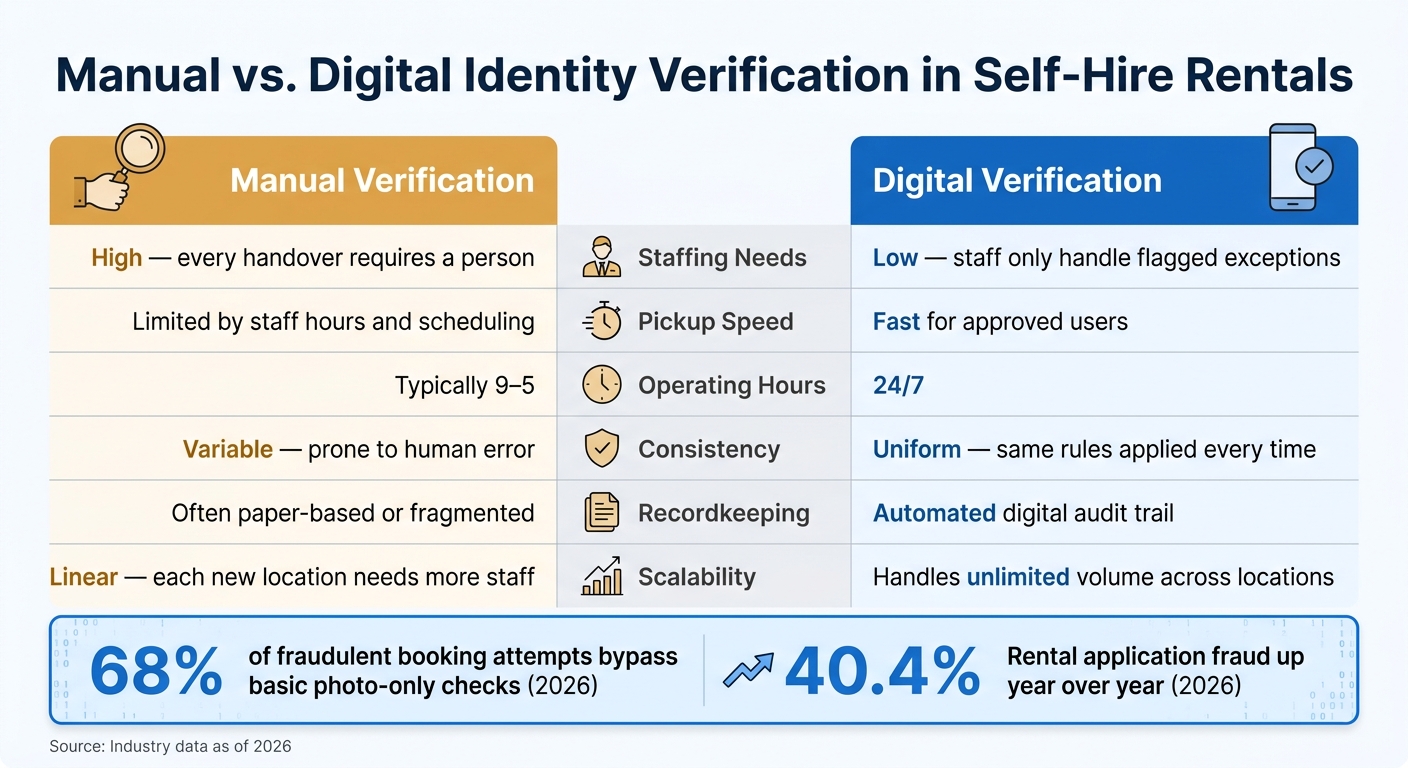
Manual check-in depends on staff being available at the right time. Digital verification doesn't. That one difference has a big effect on day-to-day operations. Staff-dependent pickup limits hours and adds coordination work, and that gets harder every time a new site is added [7].
| Factor | Manual Verification | Digital Verification | | --- | --- | --- | | Staffing needs | High; every handover requires a person | Low; staff only handle flagged exceptions | | Pickup speed | Limited by staff hours and scheduling | Fast for approved users | | Operating hours | Typically 9–5 | 24/7 [7] | | Consistency | Variable; prone to human error | Uniform; same rules applied every time [2] | | Recordkeeping | Often paper-based or fragmented | Automated digital audit trail [3] | | Scalability | Linear; each new location needs more staff | Handles unlimited volume across locations [7] |
That gap in scale is exactly why verification needs to sit inside a larger self-hire workflow. It works best when it's part of the rental platform itself, not a side task bolted on afterward.
How Lockii supports identity verification in contactless hire
Verification inside an automated self-hire workflow
This is the point where verification stops being a one-off check and becomes part of the access flow.
Lockii verifies an ID and selfie before it releases a booking-specific access PIN. It also automates customer notifications tied to the verified booking. At return, customers upload photos of the asset, which creates a condition record.
Once identity is confirmed, access control and return records become the next layer of protection.
Why this matters for trailer, vehicle, and equipment rentals
For rental categories where assets leave an unattended site, the stakes are higher. A trailer, vehicle, or piece of heavy equipment handed off without proper verification creates real operational and financial risk.
Lockii deals with this by linking verified identity directly to conditional access. In plain terms, the customer doesn’t just book the asset - they must pass verification before pickup can happen. That connection is what makes unattended pickup workable at scale.
Conclusion: where identity verification in self-hire rentals is headed
The direction is pretty clear: verification now sits inside the rental workflow, not outside it.
Application fraud in the rental industry rose 40.4% year over year as of 2026 [8], and integrated verification is what makes unattended pickup workable at scale.